
If you’ve outgrown your home but love where you live, you’re facing one of the most common dilemmas Melbourne homeowners deal with: do you renovate what you have, add more space by extending, or sell up and move somewhere bigger?
It sounds like a simple choice, but the answer depends on a combination of factors unique to your property, your suburb, your budget, and your long-term goals. The good news is that for most Melbourne homeowners, the right path becomes clear once you break the decision down properly.
This guide walks you through everything you need to know realistic 2026 costs, what each option involves, when one makes more sense than the other, and the questions to ask before you commit.
Before comparing the two, it helps to be precise about what each term means.
A renovation works within your home’s existing footprint. You’re improving, updating, or reconfiguring spaces that already exist — a new kitchen layout, a bathroom remodel, opening up walls to create open-plan living, or replacing outdated finishes throughout the home. You’re not making the house physically bigger.
An extension adds new floor area to your home. This could be a ground-floor rear addition, a second-storey addition above the existing structure, a side return extension, or a separate granny flat at the rear of the property. You’re expanding the building’s footprint or height.
In practice, many Melbourne projects combine both: a homeowner might extend the rear of the house to create a larger family room and then renovate the existing kitchen at the same time. But understanding the distinction helps you evaluate cost, disruption, and return on investment separately.
Renovation costs in Melbourne vary significantly depending on which rooms you’re targeting and how deeply you’re changing them.
The kitchen is typically the highest-cost single room in any renovation. In Melbourne in 2026, a mid-range kitchen renovation costs between $30,000 and $50,000, with premium custom designs reaching $70,000 or more. The biggest cost lever is whether you move the plumbing: keeping the sink and cooking positions in the same locations is the most effective way to keep costs down. Moving plumbing on a concrete slab adds $3,500 to $8,000 before any other work begins.
Cabinetry accounts for 30 to 40% of a typical kitchen budget. Note that the engineered stone ban that came into effect nationally on 1 July 2024 applies in Victoria with no grace period, so porcelain and Dekton are now the standard alternatives for benchtops, and comparable specifications cost $500 to $2,000 more than pre-ban quotes.
Bathrooms are labour-intensive. Despite being smaller rooms, they involve plumbing, waterproofing to Australian Standard AS 3740, electrical, tiling, and fixture installation — all of which require licensed trades. A mid-range bathroom renovation in Melbourne in 2026 typically costs between $20,000 and $45,000, with cosmetic refreshes starting from around $10,000 to $15,000 and premium ensuite transformations reaching $50,000 or more.
The most underestimated cost in bathroom renovations is waterproofing. It’s not visible once the tiles go on, but getting it wrong leads to structural damage that’s far more expensive to fix later.
A cosmetic refresh across an entire home — new flooring, paint, lighting updates, and minor fixture changes without moving walls or plumbing — typically costs between $40,000 and $90,000 for a standard Melbourne house.
A structural full home renovation, where walls are opened up, layouts are changed, and wet areas are relocated, costs significantly more. For a standard three to four bedroom Melbourne home, expect to budget between $220,000 and $450,000, and up to $450,000 or more for high-end finishes and complex structural changes.
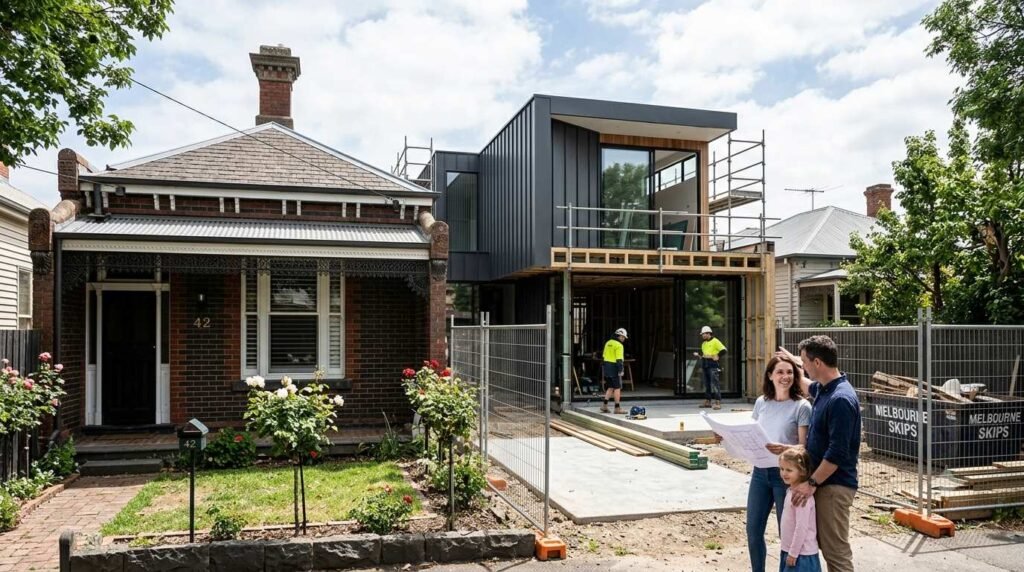
Extension costs in Melbourne vary based on whether you’re building out (ground floor) or building up (second storey), as well as your site conditions, finish level, and the complexity of connecting new work to the existing structure.
A single-storey rear or side extension is the most common type of addition in Melbourne’s established suburbs, and the most cost-effective way to gain floor area. In 2026, ground floor extensions in Melbourne typically cost between $2,500 and $4,500 per square metre for construction, depending on specification and site conditions.
As a practical guide:
These figures cover the build itself. They don’t include design fees, engineering, building permit costs, or any renovation work done to the existing parts of the home as part of the same project.
Adding a second storey typically costs 20 to 35% more per square metre than an equivalent ground-floor addition, due to structural requirements, roof modifications, stair design, and the complexity of building above an occupied home.
In 2026, second-storey additions in Melbourne typically fall within these ranges:
A modest upper-floor addition of 30 to 40 square metres therefore represents a total all-in budget of around $150,000 to $250,000, including engineering, permits, and professional fees.
Regardless of extension type, always budget for costs outside the construction contract. For a typical Melbourne extension, these include:
Together, these items typically add 20 to 30% on top of the builder’s construction quote.
One of the most important factors in the renovate-or-extend decision is the true cost of the alternative: selling your current home and buying a larger one.
In Melbourne, stamp duty on a property purchase is one of the highest in Australia. On a $1.2 million property — a common price point in established Melbourne suburbs — a non-first-home buyer pays approximately $64,000 in stamp duty alone. Add to this:
For many Melbourne families, the combined cost of selling and buying again — stamp duty, agent fees, moving costs — easily exceeds $80,000 to $120,000 before you’ve bought a single extra square metre of space. That figure often covers a substantial extension or renovation instead.
This is why, in Melbourne’s middle-ring and inner suburbs, where land is expensive and comparable homes in better areas cost significantly more, renovating or extending is so often the smarter financial decision.
Renovation is likely the right choice when:
You need a better home, not a bigger one. If the issue is a dysfunctional kitchen layout, outdated bathrooms, poor storage, or dark and disconnected living spaces, a renovation addresses the problem directly without the structural cost of adding floor area.
Your home has good bones. If the structure, footprint, and general layout of your home work well for your family, improving what’s already there is more cost-effective than building new floor area.
Your block or zoning limits extension options. Many Melbourne properties — particularly in inner-city suburbs, on narrow blocks, or in heritage overlays — have limited scope to extend without planning permits, significant setback constraints, or council restrictions. A renovation may be the most practical path.
Your budget is in the $30,000 to $150,000 range. Most extensions in Melbourne require a minimum budget of around $100,000 to $150,000 to achieve meaningful results. If your budget sits below that, a targeted renovation of your kitchen or bathroom is likely to deliver more value.
You want the highest ROI for resale. Kitchens and bathrooms consistently deliver the strongest return on renovation investment in Melbourne, with well-executed projects returning 60 to 90% of their cost in added property value. In Melbourne’s middle-ring suburbs, buyers at the $1.2 million-plus price point have strong expectations for quality kitchens and bathrooms, and dated versions are regularly used to negotiate price reductions.
An extension is likely the right choice when:
You genuinely need more floor area. If your family has grown and you simply don’t have enough bedrooms, a living area that works for both adults and children, or enough space to accommodate changing needs, renovation alone won’t solve the problem. Only adding floor area will.
Your block has the space. A ground-floor rear extension requires enough backyard depth to build into while maintaining required setbacks (typically 3 to 5 metres from the rear boundary in Melbourne residential zones, though council rules vary). If your block has 600m² or more with good rear access, you likely have room to extend at ground level.
You want to avoid moving in your suburb. If you love your street, your school zone, your commute, or your neighbours, and a larger home nearby would cost significantly more, extending is a way to get the space you need without giving up the location you’ve chosen.
You’re planning for the long term. Extensions add permanent floor area to your home and generally increase its capital value more substantially than cosmetic renovations. If you plan to stay for ten years or more, the investment case is stronger.
Your property is in a high-land-value suburb. In suburbs where land value makes up a large proportion of your home’s total value, adding floor area is a more effective way to increase overall property value than in outer suburbs where construction costs may approach or exceed the value they add.
For many Melbourne homeowners, the most effective approach is neither pure renovation nor pure extension — it’s both, planned together.
A common example: a family extends the rear of a 1980s brick veneer home to create a new open-plan kitchen, dining, and living area, and at the same time renovates the existing bathroom and master bedroom at the front of the house. By planning both together, they get a cohesive result with consistent finishes, a single period of disruption, and a single set of permit and design fees — rather than paying those twice across separate projects.
Combining a moderate extension with targeted renovation work typically costs between $200,000 and $400,000 for a standard Melbourne home, depending on the scale and finish level chosen.
Before committing to either path, work through these questions:
The renovate-or-extend decision doesn’t have a single right answer — it depends on your home, your block, your suburb, your budget, and what you’re trying to achieve. But for most Melbourne homeowners, the cost of moving in a city with high stamp duty and strong property prices makes improving the home you already have a compelling alternative to selling.
The key is starting with clarity: what’s the problem you’re solving, what does your block actually allow, and what can you realistically spend? Once those three things are clear, the right path usually becomes obvious.
At Renovation Pro, we work with Melbourne homeowners on bathroom renovations, kitchen renovations, alterations, full home renovations, and extensions across the city. If you’re weighing up your options and want an honest conversation about what’s realistic for your property and budget, get in touch for a free consultation.
This article provides general guidance on renovation and extension planning for Melbourne homeowners. Cost figures are indicative for 2026 and sourced from current industry data. Actual costs vary by project scope, site conditions, and finish level. For planning permit requirements, refer to your local council and Planning Victoria. For building permit requirements, refer to the Victorian Building and Plumbing Commission.