
Selling a home in Melbourne in 2027 is a different exercise to what it was two or three years ago. With the median Melbourne house value sitting at approximately $958,000 and buyer demand softening, higher listings and softer auction conditions are giving buyers more choice and stronger negotiating power. For sellers, realistic pricing and strong presentation are no longer optional extras — they’re essential.
That’s where pre-sale renovation comes in. A strategically renovated home doesn’t just look better at inspection — it commands a higher offer, attracts more buyers, and sells faster. But the key word is strategically. Not every renovation dollar returns a dollar at sale. In Melbourne’s current market, the homes that perform best at auction and private sale aren’t necessarily the most heavily renovated. They’re the most smartly renovated, updated in the areas buyers care about most, finished to the standard the suburb demands, and not over-capitalised beyond what the street will support.
This guide breaks down exactly which renovations add genuine value to Melbourne homes before selling, what realistic returns look like, what to avoid, and how to think about renovation spend relative to your suburb’s price ceiling.
Melbourne’s property market has gone through a significant correction since its 2022 peak. Values remain 3.2% below that high-water mark, and estimated home sales are down 14.2% compared to a year ago. In practical terms, this means buyers have more options, more time to make decisions, and more confidence to negotiate.
In this environment, presentation matters enormously. A dated kitchen or tired bathroom gives a buyer a concrete reason to reduce their offer — and in a softer market, they will use it. A well-presented, move-in-ready home removes that negotiating tool and broadens the buyer pool to include those who don’t want the stress of renovating after purchase.
Australian property research consistently ranks kitchens and bathrooms as the two highest-return renovation categories. According to Canstar Blue’s 2024 Australian Renovation Report, 73% of real estate agents nominated a kitchen renovation as the single most impactful improvement a vendor can make before listing a property.
That statistic is important context for everything that follows.
Before spending a single dollar on pre-sale renovation, you need to understand one critical concept: your suburb’s price ceiling.
Over-capitalising hurts. Renovating well above your suburb’s price ceiling rarely returns full investment. A $60,000 kitchen renovation makes financial sense in Essendon. The same kitchen in a street where homes sell for $550,000 doesn’t.
This is the single most common and expensive mistake Melbourne homeowners make before selling. They invest in a renovation that exceeds what buyers in their suburb expect to pay for, and they don’t recoup the spend at sale.
The practical rule: research recent comparable sales in your street and surrounding area before committing to any renovation budget. Your renovation spend should bring your home up to the standard of comparable properties, not significantly above it.
In Melbourne, a well-planned renovation can increase your home’s value by 5–15%, depending on what you renovate, where your property sits, and how well the work is done. Spend smart, and a $30,000 kitchen refresh could return $50,000–$80,000 at sale. Spend without a plan, and you could sink $80,000 into a home worth $70,000 more than its street value.
The kitchen is consistently the highest-priority renovation for Melbourne vendors, and for good reason.
Real estate agents across Victoria often repeat the same golden rule: “Kitchens sell houses.” If your primary goal is finding the best renovations to increase home value in Melbourne, the kitchen is usually the winner. Buyers are often willing to overlook a slightly dated bathroom if the kitchen features modern stone benchtops, high-quality joinery, and a seamless layout.
What the ROI looks like
The commonly cited industry benchmark in Australia is a 1.5x–2x return on investment for a well-executed kitchen renovation in an owner-occupied home — meaning a $50,000 kitchen investment adds $75,000–$100,000 to the property’s sale value in the right market conditions.
Kitchens consistently deliver the strongest resale ROI at 60–80%. In Melbourne suburbs where properties sell above $900,000, buyers expect a renovated kitchen as standard, an unrenovated one is disproportionately penalising and will be used to negotiate the price down.
A mid-range kitchen renovation in Melbourne in 2027 typically costs between $28,000 and $45,000. For pre-sale purposes, a targeted refresh — new benchtops, new cabinet fronts, updated tapware, and modern splashback — can achieve the buyer impact of a full renovation at a fraction of the cost. If the layout functions well and the bones are good, a cosmetic update often makes more financial sense than a full gut.
Key spending priorities for pre-sale:
What you don’t necessarily need to replace before selling: high-end appliances, a butler’s pantry, or custom joinery — unless your suburb and price bracket demand it.
A mid-range bathroom remodel in Victoria typically delivers an average return on investment of 74% in increased home value. For a room that costs $20,000 to $38,000 to renovate in Melbourne, that’s a meaningful uplift — and the non-financial return is equally significant: a renovated bathroom dramatically improves how buyers feel about a property at inspection.
The most common services driving bathroom renovation costs include plumbing, tile installation, shower or tub installation, and electrical work. 55% of homeowners said their renovation increased their home’s overall value, while 41% reported it boosted resale value specifically.
Adding a second bathroom to single-bathroom homes in Hawthorn, Camberwell, and South Yarra significantly increases resale value, particularly where demand exceeds supply. In Melbourne’s inner and middle-ring suburbs where families are competing for three and four bedroom homes, a second bathroom is increasingly an expectation rather than a bonus. If your home has only one bathroom and the layout allows for a second, this is worth pricing up seriously before listing.
For a single bathroom refresh aimed at sale, the highest-impact changes are:
Waterproofing is non-negotiable — not just legally, but because buyers increasingly ask for evidence of compliant waterproofing, and a licensed building inspector will flag it if it’s absent or inadequate.
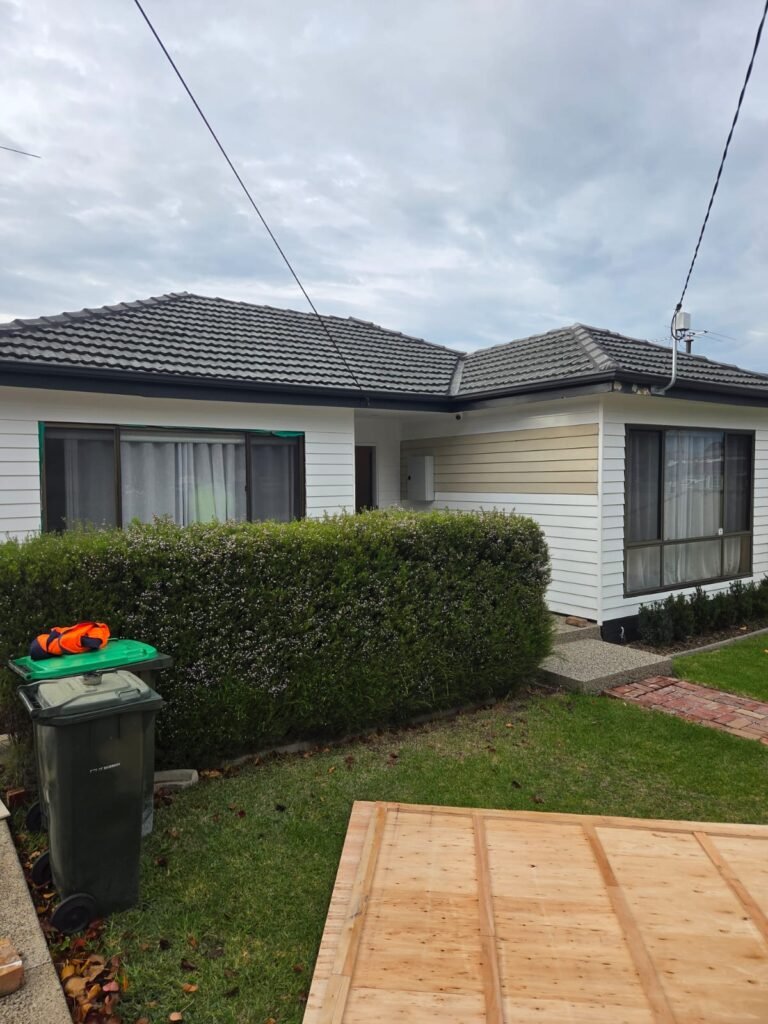
Buyers form their first impression before they walk through the front door. A home that looks tired, overgrown, or poorly maintained on the outside creates doubt that’s hard to undo inside — and in a competitive listing environment, some buyers will simply move on.
The good news is that exterior improvements deliver high visual impact at relatively low cost compared to structural renovations.
High-ROI exterior improvements for Melbourne sellers:
Flooring is one of the most visible elements in any home, and worn, stained, or dated flooring is one of the fastest ways to age a property in a buyer’s eyes. Replacing floor coverings is also one of the more cost-effective whole-home upgrades available.
For Melbourne homes targeting the $800,000 to $1.2 million market, the standard buyer expectation is engineered timber or quality laminate throughout living areas, with tiles in wet areas. Carpet in bedrooms remains acceptable, though many buyers prefer hard floors throughout.
Realistic Melbourne costs for pre-sale flooring:
Given the whole-home visual impact and the relatively modest cost compared to kitchen or bathroom renovation, flooring often delivers excellent bang-for-buck in pre-sale preparation.
Fresh internal paint is the single most cost-effective pre-sale improvement available to Melbourne homeowners. It makes a home feel clean, cared-for, and move-in ready — which is exactly what most buyers want.
A full internal repaint of a standard Melbourne house costs $6,000 to $15,000 for professional painting, depending on size, ceiling height, and condition of existing surfaces. In terms of buyer perception per dollar spent, few improvements match it.
Colour choice matters. Neutral palettes — warm white, off-white, and light greige tones — appeal to the broadest buyer base and photograph well in listing photos. Avoid bold accent walls or highly personal colour choices that buyers may need to repaint.
Open-plan layouts that connect kitchens to living areas remain the top request from buyers, with projects ranging from $20,000 for cosmetic updates to $70,000 for complete overhauls.</cite>
Removing a wall to create an open-plan kitchen and living area can significantly transform how a home feels and functions — and Melbourne buyers respond strongly to it. However, this is a structural renovation that requires a building permit in Victoria, engineering sign-off if a load-bearing wall is involved, and careful integration of flooring, ceiling, and paint to make the join seamless.
For pre-sale purposes, a wall removal to open a kitchen to the living area is worth serious consideration if:
If the wall is load-bearing, the structural work adds significant cost and should only proceed if the suburb and likely sale price support the investment.
Not every renovation is worth doing before a sale. Some improvements cost significantly more than they return, particularly in Melbourne’s current market.
Avoid these for pre-sale:
Swimming pools. In Melbourne, a pool adds cost (ongoing maintenance, fencing compliance, safety certificates) and appeals to a narrower buyer pool than most vendors assume. In family-focused suburbs it can help, but in many inner-city or smaller-block contexts, buyers see it as a liability rather than an asset.
High-end luxury additions beyond your suburb’s ceiling. A $100,000 kitchen renovation makes sense in Toorak. In Ringwood or Sunshine, the same spend may return 40 cents in the dollar at sale, if that. Always calibrate your renovation to what buyers in your suburb are willing and able to pay.
Full bathroom or kitchen renovation where a cosmetic refresh will suffice. If the bones are good — layout works, no water damage, plumbing is functional — a targeted refresh often gives you 80% of the buyer impact at 30% of the cost.
Home extensions immediately before selling. An extension is a long-term investment that works best when you’ve lived in the improved space for some time. The disruption, cost, and timeline of a full extension rarely make sense purely as a pre-sale strategy unless the lack of space is severely limiting the buyer pool.
If you’re preparing to sell and working with a finite budget, use this prioritisation framework:
Step 1 — Fix anything that signals neglect or poor maintenance. Cracked tiles, leaking tapware, broken gutters, damaged fencing, mould in wet areas. These aren’t glamorous, and they raise doubts in buyers’ minds about what else hasn’t been maintained. Fix these first.
Step 2 — Maximise kerb appeal. Front garden, exterior paint if needed, front door, driveway. First impressions drive click-throughs on real estate portals and set the emotional tone before buyers walk in.
Step 3 — Fresh paint internally. If the internal paint is more than five to seven years old or the colour is dated, repaint in a neutral palette. The cost-to-impact ratio is unmatched.
Step 4 — Address flooring. Replace worn or stained carpet and tired vinyl with quality laminate or engineered timber in living areas. Retile bathrooms and laundries if tiles are cracked or dated.
Step 5 — Kitchen and bathroom. Allocate remaining budget to the kitchen and/or bathroom. Even a targeted refresh — new benchtops, tapware, vanity — makes a measurable difference to buyer perception and offer value.
At Renovation Pro, we work with homeowners across Melbourne & Geelong on bathroom renovations, kitchen renovations, alterations, and full home renovations — including pre-sale preparation projects where timing, budget, and return are the primary considerations.
We understand Melbourne’s property market and the renovation standards buyers expect across different suburbs and price brackets. If you’re planning to sell your home and want an honest assessment of what’s worth renovating and what isn’t, get in touch with our team for a free consultation.
We’re based in Point Cook and work across all of Melbourne — from the inner suburbs to the western, northern, eastern, and bayside corridors.
This article provides general guidance on pre-sale renovation strategy for Melbourne homeowners. ROI figures cited are indicative industry benchmarks and vary based on property type, suburb, market conditions, and renovation quality. For property-specific advice, consult a licensed real estate agent familiar with your suburb before committing to any renovation spend.